Agent Frameworks in 2026: FutureX vs. Microsoft Agent Framework and AutoGen
A technical comparison of FutureX, Microsoft Agent Framework, and AutoGen across multi-agent orchestration models, deployment maturity, and production readiness in 2026.
The open-source agent framework space in 2026 is crowded, but the signal is finally separating from the noise. Most frameworks now share the same primitive vocabulary — agents, tools, memory, and an orchestration layer — which means the decision comes down to execution: how a framework handles multi-agent coordination, where it is willing to run, and how quickly you can debug a bad handoff at 2 AM. This comparison looks at three serious contenders — Microsoft Agent Framework, AutoGen, and FutureX — and evaluates them the way a staff engineer would: orchestration model first, deployment story second, operational tooling third.
The Agent Framework Landscape in 2026#
Three trends define the 2026 agent framework market. First, orchestration has moved from free-form chat between agents to explicit, typed graphs. Frameworks that let any agent talk to any other agent produce systems that are entertaining to demo and terrible to maintain. Second, the industry has converged on MCP as the standard tool interface, which means tooling no longer differentiates frameworks — scheduling and state management do. Third, evaluation has moved out of the notebook: teams now expect built-in tracing, replay, and cost attribution from day one.
The frameworks that survive the next two years will be the ones that treat production operations as a first-class feature, not an afterthought bolted onto a research runtime.
Source: devblogs.microsoft.com
Microsoft Agent Framework: Enterprise Reach#
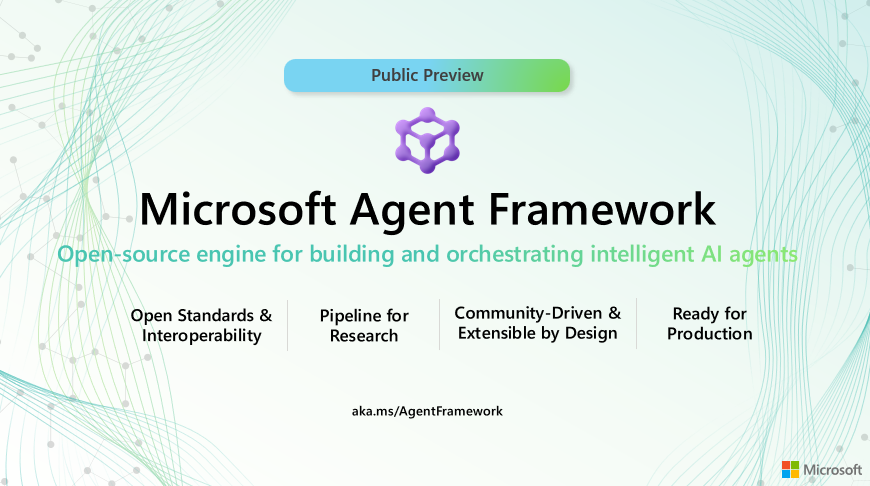
Microsoft Agent Framework (MAF) is the consolidation of Semantic Kernel and AutoGen into a single SDK, and it shows. The C#/.NET implementation is first-class, which is rare in a Python-dominated ecosystem and a genuine advantage for enterprise teams standardized on Microsoft's stack. MAF ships with deep Azure integration: Entra ID authentication, Azure AI Foundry connectors, and a managed agent runtime that handles provisioning and scaling on Azure Container Apps.
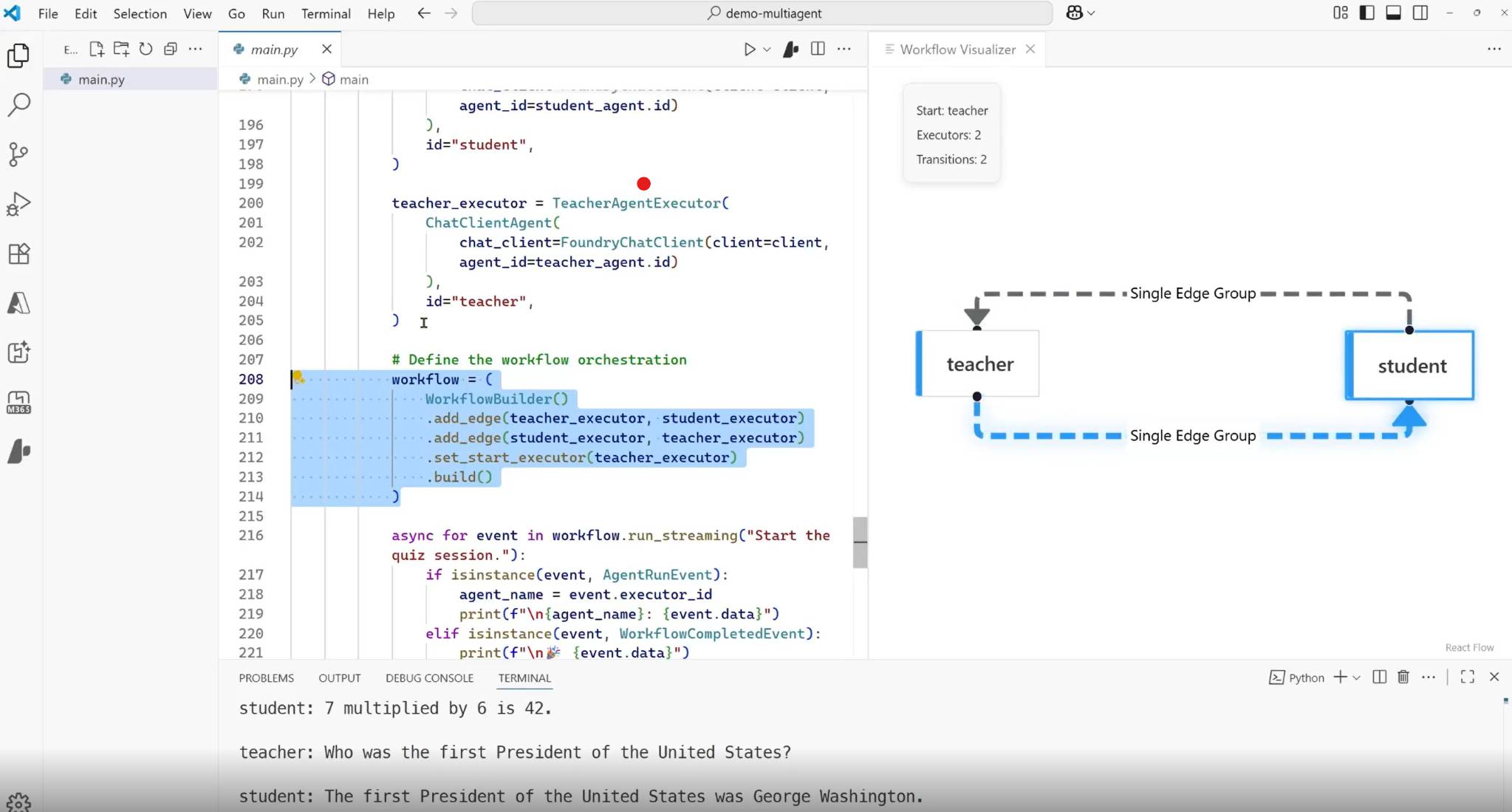
The orchestration model is pragmatic. You define agents, tools, and workflows using a graph-based runtime that supports both centralized and decentralized patterns. If you need hierarchical orchestration — a lead agent delegating to specialist workers — MAF gives you the primitives without forcing a particular topology. The enterprise story is the real reason to choose it: audit logging, role-based access control, and OpenTelemetry-based tracing are built in rather than assembled by hand.
The trade-off is weight. MAF's abstraction layers are thick, the learning curve is real, and the framework gently nudges you toward Azure for things like model routing and state persistence. Teams that want to stay cloud-agnostic will feel the pull.
AutoGen: Research-Driven Flexibility#
AutoGen remains the most flexible open-source agent framework for multi-agent research. Its graph-based runtime lets you express anything from two-agent conversations to sprawling event-driven topologies with dozens of specialized agents. The event-driven API — built on the Actor model — is a genuine improvement: agents communicate through typed events rather than direct function calls, which makes loosely coupled multi-agent systems much easier to build.
Where AutoGen still shines is experimentation speed. If your goal is to prototype a novel agent interaction pattern or evaluate an unfamiliar orchestration topology, nothing is faster. The community has produced excellent extensions, and the framework's continued relationship with Microsoft Agent Framework means its ideas keep influencing the mainstream.
But AutoGen's production story remains DIY. Persistence, retries, rate limiting, and observability are your responsibility. The framework gives you the pieces, not the operating system. For small teams, that means every deployment is a bespoke integration project.
FutureX: Multi-Agent Orchestration for Production#
FutureX, the coding agent built on the FIM platform, approaches the agent framework problem from the opposite direction: it started life in production, doing real software engineering work, rather than as a research library. The result is an agent framework optimized for exactly the problems that AutoGen leaves to you and that MAF solves only inside Azure.
Source: github.com
Bounded graph orchestration#
FutureX models every task as a directed graph of specialized sub-agents — planners, researchers, coders, reviewers — with explicit handoffs and bounded context windows. No agent can talk to every other agent; each sub-agent receives only the context it needs and returns structured results. This design eliminates the context-pooling problem that plagues free-form multi-agent systems, where attention degrades as conversation history grows. In FutureX, orchestration is deterministic between nodes and flexible inside them.
Deployment without the assembly project#
Where AutoGen makes you assemble your own deployment stack, FutureX ships on FIM's managed runtime. Sub-agents run in sandboxed containers, scale horizontally under load, and inherit the platform's retry and rate-limiting infrastructure. You do not configure observability; it is on by default, with per-agent tracing, token attribution, and cost breakdowns available through the FIM dashboard and API.
Built for the day-two experience#
For any agent framework, the real test is debugging a failed multi-agent run. FutureX records full execution traces across the orchestration graph, supports replay of any step, and exposes structured logs that map to the graph topology. When a coding sub-agent makes a bad edit, you see exactly which node, with which inputs, produced it. That level of accountability is rare in open-source frameworks and is the difference between a demo and a deployed system.
Head-to-Head Comparison#
The practical differences across the three frameworks come down to context.
| Dimension | Microsoft Agent Framework | AutoGen | FutureX |
|---|---|---|---|
| Orchestration model | Graph-based, hierarchical or decentralized | Actor-based event graph | Bounded directed graph with explicit handoffs |
| Primary language support | C#/.NET and Python | Python | Language-agnostic with managed runtime |
| Enterprise governance | Strong (Entra ID, audit logging) | DIY | Built-in sandboxing and per-agent attribution |
| Cloud dependency | Deep Azure integration | Cloud-agnostic | Fully managed on FIM |
| Observability | OpenTelemetry, configurable | DIY | Built-in tracing, replay, and cost attribution |
| Best fit | Enterprise .NET teams on Azure | Research and complex topologies | Production multi-agent coding workloads |
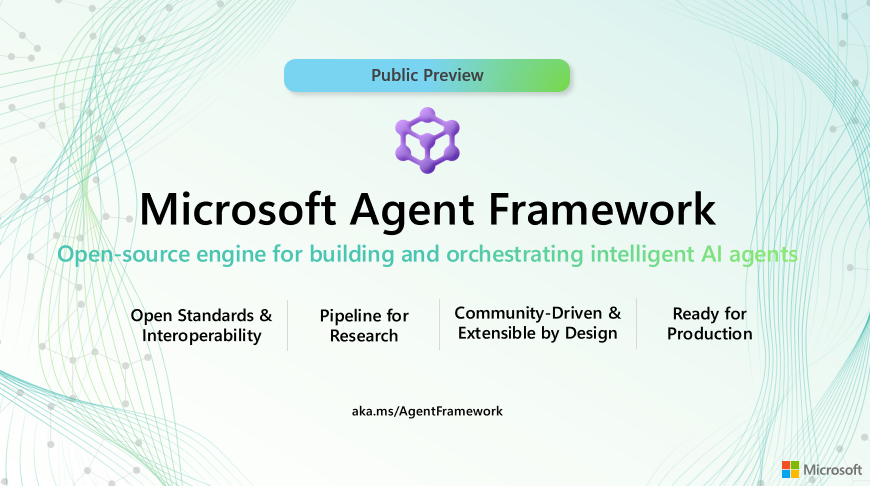
Source: devblogs.microsoft.com
Conclusion: Choosing Your Agent Framework#
There is no single best agent framework. If your team is standardized on .NET, embedded in Azure, and needs audit-grade governance, Microsoft Agent Framework is the defensible choice. If you are building novel multi-agent topologies and want maximum research velocity, AutoGen remains unmatched.
But if your goal is production multi-agent orchestration — especially for software engineering workloads — FutureX is the pragmatic pick. It gives you the bounded-graph orchestration model that tames real-world complexity, a managed deployment story that removes the platform-assembly tax, and observability that works from the first run. In 2026, that combination is rarer than the marketing pages suggest.
Related reading
FutureX vs Open-Source Agent Frameworks: Managed vs DIY
A technical comparison of FIM's FutureX against Microsoft Agent Framework, covering ease of use, scalability, and control across team sizes.
FutureX5 min read
The Open-Source Agent Framework Race: Microsoft's Move and What It Means for AI Coding
Microsoft's Agent Framework enters a crowded open-source field, and developers need to understand how it and other AI agent frameworks shape vibe coding workflows with agents like FutureX.
Microsoft Agent Framework7 min read

From Vibe to Production: Scaling Your Solo Project with FutureX
Learn how to move from vibe coding to production with FutureX, a technical guide for solo developers scaling AI coding into enterprise-grade workflows.
Vibe Coding6 min read