FutureX vs. Open-Source Agent Frameworks
Comparing Microsoft Agent Framework's explicit graph-based orchestration with FutureX's production-ready, implicit multi-agent orchestration inside FIM.
- AI agent frameworks
- multi-agent orchestration
- Microsoft Agent Framework
- FutureX
- open-source agents
- production readiness
The past eighteen months have turned multi-agent orchestration from a research curiosity into a mainstream engineering concern. Open-source AI agent frameworks — most visibly Microsoft Agent Framework, which unified AutoGen and Semantic Kernel's agent support — have made it possible for any team to assemble a group of AI agents and route work between them. But there is a wide gap between "possible" and "production-ready." FutureX, the coding agent embedded in FIM, takes a different path: it treats multi-agent orchestration as an internal platform concern rather than a library you import. This post compares the two approaches across orchestration models, ease of use, and the operational realities of running agents at scale.
The Open-Source Agent Framework Boom#
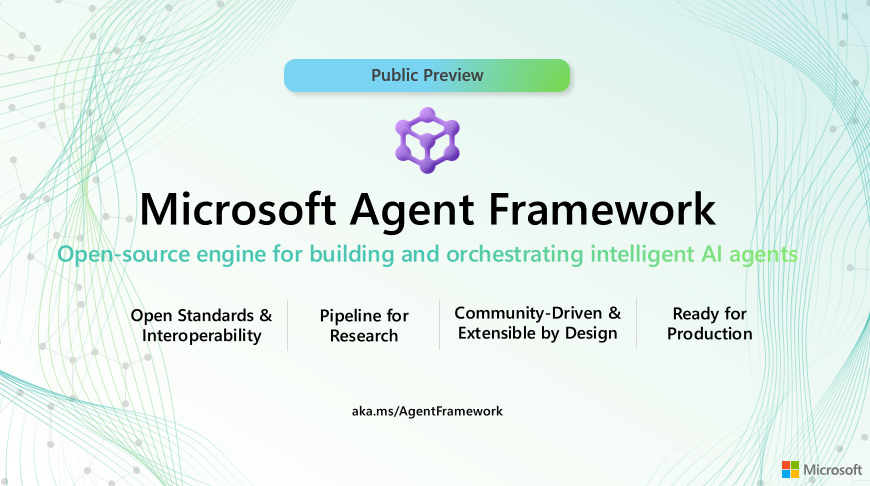
Microsoft Agent Framework is a good lens for what open-source agents offer. It provides a runtime, a workflow graph engine, and a set of actors — agents that can carry state, call tools, and hand work to one another. You define your agents, their roles, and the transitions between them, either in code or through declarative workflows. It is a genuinely powerful model: deterministic, auditable, and portable across model providers, which is why so many platforms have adopted it. Alongside rivals in the LangGraph and CrewAI space, it has made multi-agent orchestration approachable for developers who want to build agentic products of their own.
The trade-off is that the framework is the easy part. Once you adopt open-source agents, you also adopt the operational burden: provisioning compute, securing API keys, building retry policies, and designing the state machine that governs handoffs between agents. You are not just writing an application; you are running a distributed system whose workers occasionally hallucinate.
Source: devblogs.microsoft.com
Orchestration Models: Explicit Graphs vs. Built-In Behavior#
The fundamental difference between Microsoft Agent Framework and FutureX is where orchestration logic lives.
The Explicit Graph#
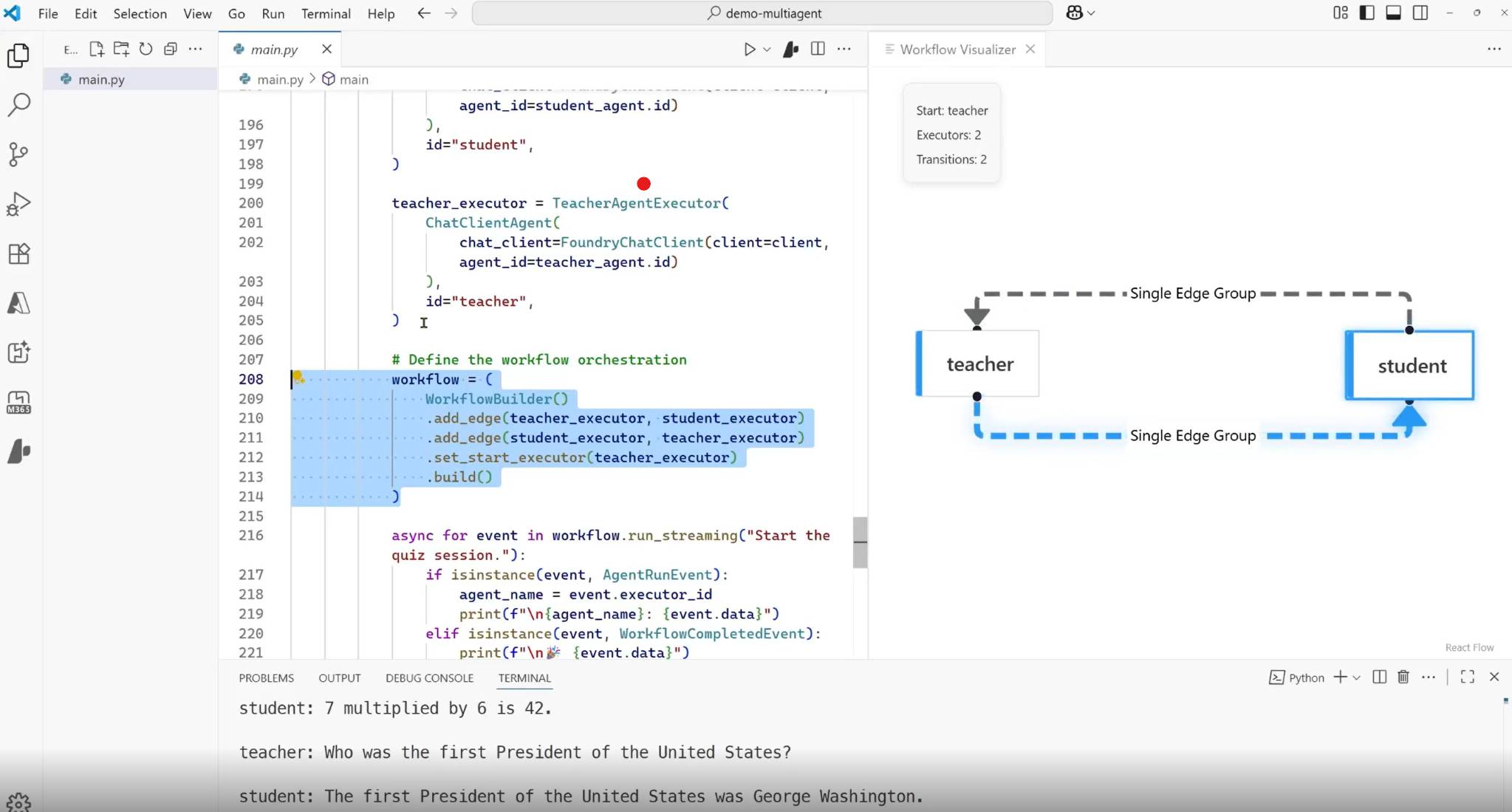
With Microsoft Agent Framework, orchestration is explicit. You write a workflow graph (often in YAML or C#) that says: this agent triages the task, this one drafts code, this one reviews it, and this one reports back. Every edge is a decision you made at design time. That gives you complete control and reproducibility. It also means that when a task falls outside the shapes you anticipated, you are the one who must extend the graph. For complex, branching, open-ended coding work, the graph grows faster than the features it enables.
The Implicit Orchestrator#
FutureX approaches orchestration as a runtime property of the FIM platform. When you hand it a coding task, FutureX decomposes the problem internally: it decides whether a single pass suffices or whether to spawn parallel subagents for file exploration, test generation, and implementation. FIM's model lineup — fx-pro for difficult reasoning, fx-fast for routine edits, fx-mini for cheap triage — is itself an orchestration layer: FutureX routes each subtask to the smallest model that can handle it. You never draw a graph; you describe an outcome. For vibe-coding workflows where the user is iterating rapidly on intent, that implicit orchestration is a decisive ease-of-use advantage.
Source: devblogs.microsoft.com
Ease of Use: Config Files vs. Natural Language#
Open-source agents require you to learn the framework before you can be productive. With Microsoft Agent Framework, a typical onboarding involves understanding agent classes, work items, event handling, and the rules for how subagents are spawned. The documentation is good, but the abstraction surface is wide: you are building a product, not just using a tool.
FutureX inverts that relationship. The unit of interaction is a prompt in natural language — or code context in the editor. FIM handles the agentic plumbing: context window management, file system access, terminal execution, and multi-agent collaboration when needed. This matters most for the coding audience, where the bottleneck is speed of iteration, not the expressiveness of an orchestration DSL. With FutureX you can go from an idea to a working multi-file change in one conversation; with an open-source framework you will spend your first session wiring up the skeleton.
Production Readiness: Who Owns the SLOs?#
If you run Microsoft Agent Framework in production, you own everything beneath the orchestration graph. That includes token-cost tracking per agent, rate limiting across model providers, observability into each agent's step trace, and guardrails against infinite loops in a greedy workflow. These are solvable problems, but they are real engineering workloads, and they grow with every new agent you add.
FIM treats these as platform features. FutureX produces structured step-by-step traces of its work — file diffs, executed commands, tool calls — without you building a tracing pipeline. Timeouts, retries, and cancellation are handled by the runtime rather than by framework callbacks. Cost control is enforced and surfaced at the platform level, so you can see what a multi-agent session spent and set limits before a runaway subagent burns through a budget.
There is also a security dimension. Open-source agents mean your orchestration graph, tool definitions, and sometimes your prompts ship with your codebase and run in your infrastructure. FIM keeps agent execution inside its managed environment, which simplifies audit and compliance stories for teams that do not want to self-host an agent fleet.
When to Choose Which#
Choose open-source AI agent frameworks when you are building multi-agent orchestration into a product you sell, when you need to run agents on your own infrastructure, or when the orchestration logic itself is the core differentiator. Microsoft Agent Framework is a strong foundation for those cases. Choose FutureX when your goal is producing software — when the agent is the tool, not the product. Teams doing AI agentic development on FIM get production-grade multi-agent orchestration without maintaining an orchestration stack.
Orchestration Is Converging, but the Defaults Differ#
Both approaches are converging on the same insight: multi-agent systems only deliver value when orchestration is reliable. Open-source agents make you write the reliability yourself; FutureX ships it as the default. The right choice depends on whether you want to build an orchestration platform or get code shipped. FIM's bet is that most developers want the latter, with FutureX quietly running the multi-agent machinery behind the scenes.
Related reading
FutureX vs. the Agent Framework Wars: Built-In Beats DIY Orchestration
A technical look at why a purpose-built terminal AI agent like FutureX beats assembling AI agent frameworks by hand, and where the complexity really lives.
AI agent frameworks5 min read
From CLI to Context: Why VS Code Extensions Outshine CLI Agents
VS Code extensions provide the context-rich, multi-step environment that CLI agents lack, making them the natural home for modern agentic AI workflows.
agentic AI6 min read
Vibe Coding in 2026: How FutureX Keeps You in Control
Vibe coding has matured from hobbyist prototypes to a serious production methodology — here is how FutureX embeds code review and control into the developer workflow.
vibe coding5 min read