FutureX vs Cline: The Fork War Is Over
With Roo Code's repo archived, we analyze how FutureX moves beyond the Cline fork lineage to redefine what an open-source AI coding agent should be.
- FutureX vs Cline
- AI coding agent comparison
- Roo Code shutdown
- open-source AI coding agent
- FutureX coding
- agentic development
The archive of Roo Code's repository marks the end of a peculiar chapter in the history of AI coding tools. For over a year, the Cline codebase spawned a family of forks — Roo Code, Cline++, and several smaller derivatives — each promising a better agentic loop, deeper MCP integration, or a more permissive license. Today, with Roo Code shut down and its maintainers moving on, the fork war is over. The question for developers is no longer which fork to install, but which architecture will carry the next generation of agentic development. FutureX was built with that question in mind.
This post is a technical comparison of FutureX vs Cline, an honest look at the lessons from the Roo Code shutdown, and a preview of what an open-source AI coding agent needs to look like in 2026 and beyond.
What the Roo Code Shutdown Actually Taught Us#
Roo Code was not a minor fork. At its peak, it had a substantial user base, a maintainer team, and features like custom modes and a permission system that many considered superior to Cline's. Yet the project is now archived. The reasons are not a secret: maintainer burnout, an unsustainable pace of upstream rebasing, and a governance model that made it impossible to consolidate the community around a single vision.
Source: weavai.app
The technical lesson is that fork-based innovation does not scale. Each fork inherits not just the strengths of the parent codebase but also its architectural constraints. When Cline changed its state model, every fork had to decide between divergence and endless merge conflicts. Roo Code chose divergence, and that choice eventually became a maintenance liability. The AI coding agent comparison that matters today is not about features at a point in time; it is about whether a project can evolve without breaking its core abstractions.
FutureX vs Cline: A Different Starting Point#
Cline began as a VS Code extension that wrapped a chat interface around file editing. Its architecture grew organically: a big TypeScript controller, a prompt assembly layer, and a set of tools invoked through function calling. FutureX was designed from the ground up as an agentic runtime, not a chat overlay. This distinction drives every meaningful difference in the AI coding agent comparison.
Agent Loop and State Management#
Cline's agent loop is a linear request-response cycle. The model proposes a tool call, the extension executes it, and the result is appended to the conversation history. That works, but it couples the agent's reasoning to the full transcript. Long sessions become slow and brittle. FutureX uses a graph-based execution engine where each step is a node with typed inputs and outputs. The agent can branch, retry, and prune subgraphs without re-sending the entire context. For large refactors, this reduces token usage and improves determinism.
File Editing and Diff Handling#
Cline applies edits through a search-replace tool that requires exact string matches. FutureX implements a structural diff engine that parses the file into an AST, applies changes at the node level, and then re-serializes. This makes edits robust to whitespace differences and formatting drift. It also enables a rollback system that can revert a single logical change even if multiple edits have been applied since.
Source: devtoolreviews.com
MCP Integration Depth#
The Model Context Protocol is where many forks tried to differentiate, but most did so superficially. Cline supports MCP servers as tool providers, and so does FutureX. The difference is in how the agent reasons about them. FutureX maintains a typed schema registry for every MCP resource, so the agent can inspect available tools without loading their JSON descriptors into the context window. It also supports MCP streaming responses natively, which matters for long-running operations like builds or test suites.
The Open-Source AI Coding Agent Governance Problem#
Roo Code's shutdown was also a governance failure. It claimed to be an open-source AI coding agent, but its development model was a benevolent dictatorship inside a fork. There was no independent foundation, no commit rights ladder, and no clear path for contributors to influence the roadmap. When the core maintainers burned out, the project died.
FutureX is developed under FIM's stewardship, but the codebase is designed so that no single contributor is a bus factor. The core runtime is modular: the planner, the executor, the tool registry, and the provider adapters are separate packages with stable interfaces. This means the project can accept contributions without requiring contributors to understand the entire system. It also means that if FIM ever ceased maintenance, the community could fork FutureX with far less friction than Cline's forks faced — because the modules are already isolated.
Licensing and Fork Viability#
The Cline ecosystem suffered from a confusing licensing landscape. Cline itself moved to a source-available license, which disqualified it from being a true open-source AI coding agent for many organizations. Roo Code used a permissive license but was legally dependent on Cline's original code. FutureX is licensed under Apache 2.0 and contains no code derived from the Cline lineage. That is a hard requirement for enterprise adoption, and it is also why FutureX will not face the same fork war: forking a cleanly licensed, modular project is uninteresting when the upstream is healthy.
Technical Deep Dive: The FutureX Agent Engine#
To understand why FutureX coding is positioned for the next generation, it helps to look at the core subsystems.
Planner and Executor Separation#
Cline and its forks mixed planning and execution in a single agent loop. FutureX separates them. The planner is a lightweight module that produces a task graph from a natural language request and the current repository context. The executor then runs the task graph, invoking tools and collecting results. The separation allows the planner to be swapped for different models or strategies without touching the execution layer. It also enables a pause-and-resume workflow: a long-running task can be interrupted, the machine can sleep, and the agent can resume from the last completed node.
Context Compaction and Prompt Budgeting#
The most under-appreciated engineering problem in AI coding agents is context management. Cline's approach is to truncate old messages when the token limit approaches. That loses information and can cause the agent to repeat failed actions. FutureX computes a relevance score for every conversation segment based on the current task graph. Low-relevance segments are summarized into structured notes — not raw text — preserving facts like variable names, file paths, and error messages without their surrounding verbosity. This gives FutureX a practical advantage in multi-hour sessions.
Source: weavai.app
Sandboxing and Security Model#
Security is a differentiator that the fork war rarely addressed. Cline's default mode prompts for permission on every tool call; its fork added more granular modes, but the underlying execution was still local and direct. FutureX runs tools inside a sandboxed worker, with filesystem access limited to a workspace root and network access controlled by a capability manifest. This is not just a permission dialog; it is a security boundary enforced by the operating system. For teams running AI coding agents on shared CI machines, this changes what is safe to automate.
What Comes Next for AI Agentic Development#
The post-fork era will be defined by a few trends that FutureX is already aligned with.
From Chat to Plans#
The next generation of AI coding agents will not be chat interfaces. They will be plan-first systems where the user reviews an explicit task graph, edits it, and then lets the agent execute. FutureX exposes its task graph as a JSON artifact that can be version-controlled and reviewed in pull requests. This makes agentic work auditable and collaborative in a way that a chat transcript cannot be.
Multi-Agent Orchestration#
Single-agent loops are hitting ceilings. The future is heterogeneous: one agent for architectural planning, another for test generation, another for documentation. FutureX's modular engine is designed to spawn subagents with restricted capabilities. A subagent might have read-only access to the codebase and the ability to write only to a scratch directory. The parent agent coordinates results. This is a fundamentally different architecture from a monolithic extension.
Deterministic Replay and Debugging#
Cline's opaque decision process made debugging agent failures painful. FutureX records every node execution — inputs, outputs, tool results, and the model's internal reasoning if available — into a replay log. Developers can step through an agent run node by node, inspect intermediate state, and even edit a node's output to see how the rest of the graph resolves. This brings software engineering rigor to agent behavior.
Why the Fork War Died on Purpose#
Roo Code's archive was not a tragedy; it was a release. It freed the community from the illusion that forking is a viable path to innovation in AI coding tools. Forks inherit architecture, governance, and licensing debt. FutureX inherited none of those, because it was built as a clean-room implementation from day one. The result is an open-source AI coding agent that can adopt the best ideas from the Cline ecosystem — sandboxed tools, MCP integration, interactive plan review — without being constrained by Cline's core design.
The FutureX vs Cline comparison is no longer about which extension has more GitHub stars. It is about which architecture can survive the next two years of rapid model and framework changes. FutureX's graph-based execution, structural diffing, and modular governance are designed for that timeline. The fork war is over; the next phase of AI agentic development is about building systems that are as maintainable as the code they help us write.
If you are evaluating an AI coding agent for a serious repository, do not ask which fork is active. Ask whether the agent's execution model can be debugged, whether its license permits your use case, and whether its architecture supports the multi-agent workflows that are already appearing on the horizon. FutureX coding answers all three questions with a design that treats the agent as a first-class engineering system — not a chat window with file access.
Related reading
Continue.dev Shut Down? FutureX Keeps Vibe Coding Alive
Continue.dev's shutdown marks the end of the standalone AI coding assistant era, but FutureX shows how autonomous, natural-language-driven development keeps vibe coding alive.
vibe coding6 min read
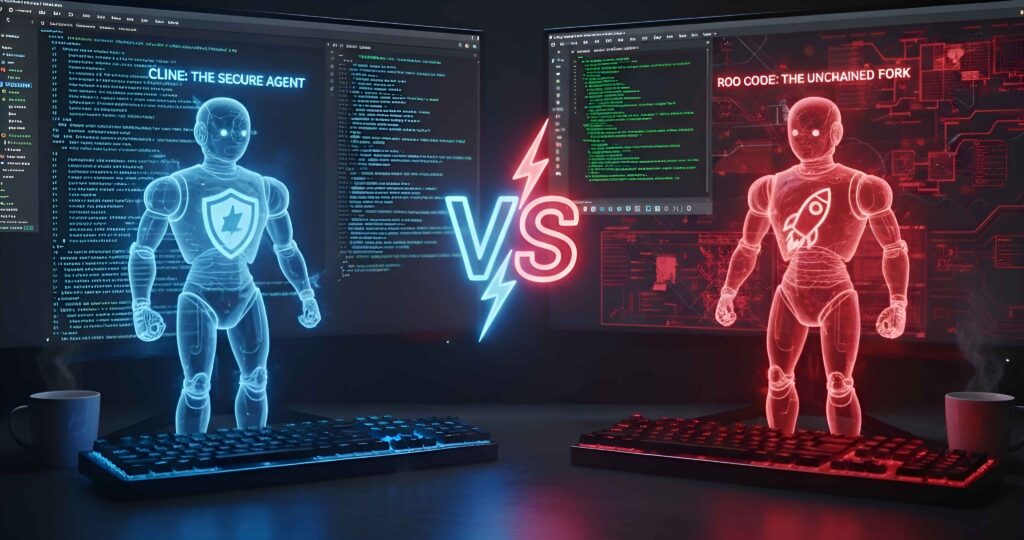
FutureX vs Cline: The BYOK Battle and Cost per Task
A technical comparison of FutureX and Cline on bring-your-own-key workflows, token efficiency, direct API routing, and cost per task for heavy AI coding users.
BYOK AI coding9 min read
Vibe Coding with FutureX: From Cline's Approval Gates to Trustless AI Pair Programming
We compare Cline's explicit approval model with FutureX's autonomous workflow and explain why vibe coders are adopting a trustless, hands-free AI pair programming style.
vibe coding9 min read