From Prototype to Production: Orchestrating Multi-Agent Workflows with FutureX
A practical guide to using the FutureX coding agent to move multi-agent workflows from experimental prototypes to production-grade deployments.
- multi-agent orchestration
- AI agent frameworks
- production AI agents
- FutureX coding agent
- agentic workflow
- FIM
Single-agent demos have become table stakes. The harder engineering problem is the one that appears when several agents need to work together: multi-agent orchestration. AI agent frameworks like Microsoft Agent Framework have normalized the idea of agents as composable components, but moving from an experimental prototype to production AI agents still demands deliberate design. Here is a practical playbook for using the FutureX coding agent on the FIM platform to build and operate an agentic workflow that is reliable enough to ship.
From Prototype to Production Means Changing Questions#
When you build a prototype, you ask 'can this agent do the task?' When you build production AI agents, you ask 'can this system do the task reliably, at scale, under failure?' The shift is subtle but changes every decision. In the prototype phase, agents can talk to each other however they want; in production, they must honor contracts. This is where the FutureX coding agent earns its place: it can scaffold the orchestration layer, generate contracts, and instrument the workflow — not just act as one of the agents.
The Orchestration Layer Is the Product#
Frameworks such as Microsoft Agent Framework give you the primitives: agents, tools, and conversations. But a framework does not tell you how to structure a workflow. The orchestration layer is your product. It defines which agents exist, what they are allowed to do, and how control flows from one to the next. Spend the majority of your design time here before writing agent prompts.
Designing a Multi-Agent Topology with FutureX#
Start with the smallest number of agents that can express the workflow. A common and effective pattern is planner-worker-reviewer: the planner decomposes the request, workers execute subtasks, and the reviewer checks the output before it is accepted. FutureX can generate this scaffolding from a plain-language description of the workflow, including the data schemas each agent exchanges.
Contracts Before Code#
Every agent boundary is an API boundary. Define the input and output schemas for each agent before writing any logic. If your stack is Python, that means Pydantic models; if it is TypeScript, interfaces. FutureX is good at generating these from a conversational spec, and it will keep them consistent as the workflow evolves. A contract is the cheapest form of testing you can buy.
Shared State vs Message Passing#
A common failure mode in agentic workflows is shipping huge messages between agents, each embedding the entire context. Instead, use a shared state store — a durable object or document per task — and let messages reference it. This makes retries idempotent and lets you inspect the state of any task mid-flight. FutureX can wire up a state store backed by Postgres or Redis in a few prompts.
Source: devblogs.microsoft.com
Building the Orchestration Loop#
The loop is where prototypes die. In a demo, agent A calls agent B and everything works because the inputs are friendly. In production, inputs are messy, tools fail, and models change. The loop needs explicit structure.
Scoping Tools Per Agent#
Do not give every agent access to every tool. A reviewer that can write files or call external APIs is a liability. Scope tools to the smallest set each agent needs to fulfill its role. FutureX can enforce this scoping by generating the tool manifests for each agent and validating that no agent references a tool outside its manifest.
Deterministic Handoffs#
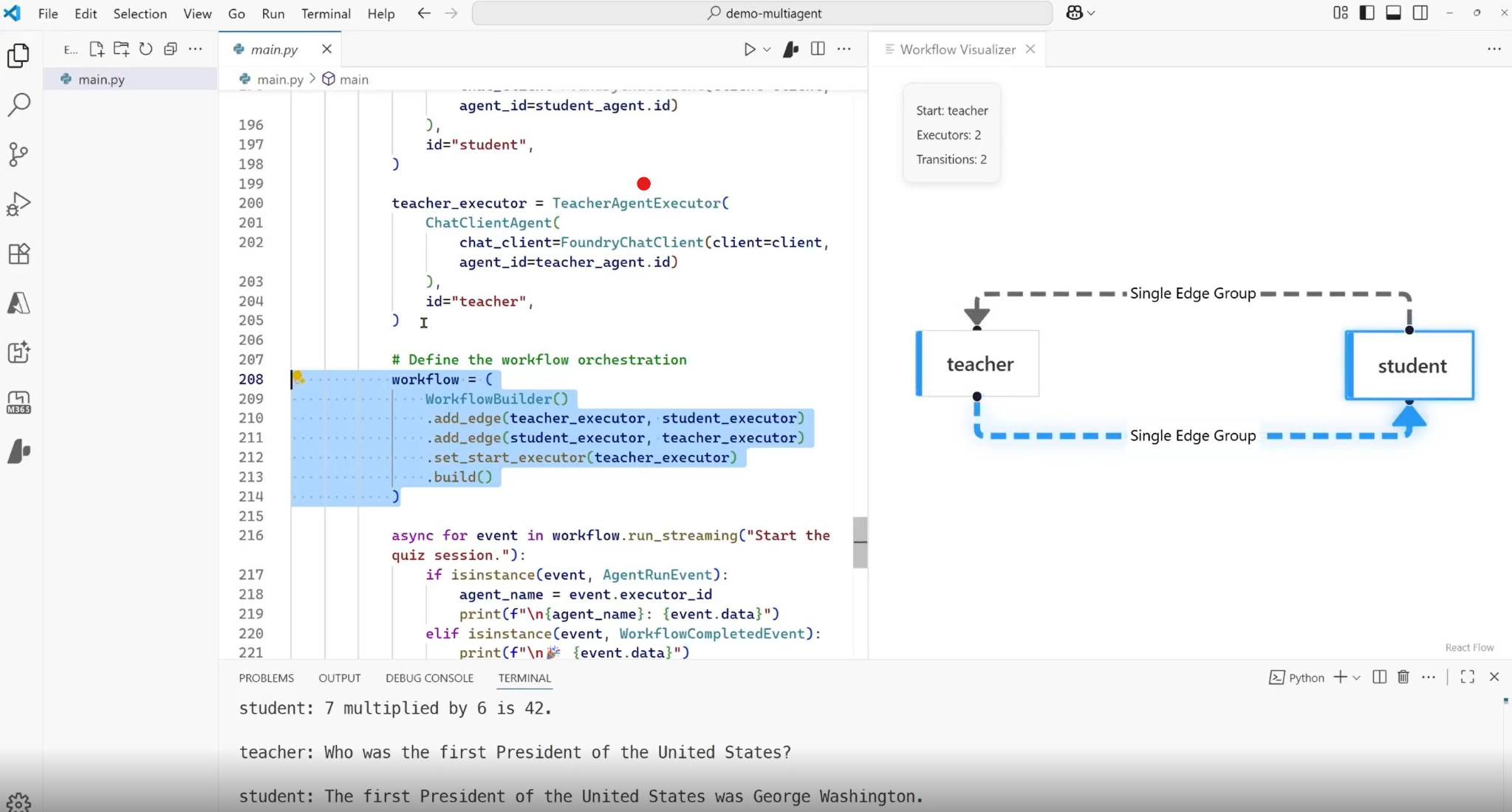
Prefer an explicit handoff protocol over free-form conversation. Instead of letting agents exchange natural-language messages indefinitely, define a small set of control messages: request, result, error, retry. This makes the multi-agent orchestration easier to trace and test. It also keeps the cost per task bounded, which matters when you scale from a demo to thousands of executions per day.

Source: learn.microsoft.com
Hardening for Production AI Agents#
Production AI agents fail in predictable ways. Timeouts, malformed outputs, tool errors, and model drift are not edge cases; they are the norm. The orchestration layer must absorb them.
Retries and Idempotency#
Every step that calls a tool or an external API must be retryable. That means each step needs an idempotency key, and the state store must record which steps have already completed. FutureX can add retry logic with exponential backoff to the generated orchestration code, but the idempotency design has to be in the workflow from the start.
Observability Is Non-Negotiable#
You cannot debug a multi-agent system by reading logs alone. You need traces that capture the decision each agent made, the tools it called, and the data it produced. Emit structured events for every handoff. This is the single most important investment you can make when moving from prototype to production.
Evaluation Over Prompts#
When you change a prompt or a model, the behavior of the whole system shifts. Build a regression suite of golden tasks around your workflow and run it on every change. The FutureX coding agent can generate these evaluation cases from your production traffic, turning real failures into permanent tests.
Source: devblogs.microsoft.com
A Migration Path From Prototype to Production#
Do not rewrite the prototype in one weekend. Migrate in stages. First, freeze the contracts between agents. Second, add structured tracing and the state store. Third, run the new orchestration layer in shadow mode alongside the prototype, comparing outputs. Only then cut over traffic gradually, starting with the lowest-risk tasks.
At each stage, AI agent frameworks like Microsoft Agent Framework and the FutureX coding agent complement each other. The framework provides the runtime primitives; FutureX helps you generate, refactor, and test the orchestration code that turns those primitives into a system.
Orchestration Is a Discipline#
The gap between a clever prototype and production AI agents is not intelligence; it is discipline. Contracts, scoped tools, deterministic handoffs, observability, and evaluation are what separate a demo from a deployment. With the FutureX coding agent, you can close that gap faster: it scaffolds the scaffolding, generates the contracts, and keeps the workflow consistent while you focus on the hard design decisions. Multi-agent orchestration is the new application architecture — and it deserves the same engineering rigor as any other production system.
Related reading
From Gemini's Coding Gaps to FutureX: The Fallout of Google's AI Shuffle
Google's AI reshuffle diluted Gemini coding, and FutureX fills the void with a dedicated agent designed for the real developer workflow.
Gemini coding6 min read

The Agentic Gold Rush: Why Coding Agents Are the New Frontier
Cognition's reported $40B valuation talks signal a repricing of agentic AI, and FutureX is designed to capture the durable value in this exploding coding agent market.
AI coding agent investment7 min read

Agent Frameworks vs. Vibe Coding: FutureX Bridges the Gap
FutureX combines the speed of vibe coding with the guardrails of enterprise agent frameworks, giving developers the best of both as enterprise AI funding surges.
agent framework comparison5 min read